284
CHAPTER 25
Air in the room was circulated slowly by means of a small electric fan to avoid gradients.
The study at 35~37°C was made in a specially constructed heat chamber (Guttmann,
1947) (Fig. 123). The heat source was a series of infra-red electric heaters in the roof of
the 'hot box', but the patient was shielded from direct radiation. The air heated in this
way was circulated slowly. Humidity in the 'hot box' was constant between 40-50 per
cent during the exposure of the cervical subjects, but tended to rise to 60-70 per cent
when the other subjects, who sweated, were studied. The temperatures given of all the
environmental conditions were globe thermometer readings, as they take account of
radiation. Globe thermometer readings in the hot box were approximately 20°C higher
than the air temperature but were within i°C in the neutral and cold temperatures.
The sweat glands function was detected by the Quinizarin Dye Method which has been
shown to be very sensitive (Guttmann, 1937, 1947).
Rectal temperature was measured every 15 min with a clinical rectal thermometer.
Skin temperature was measured by means of a copper-constantan thermocouple stretched
over a Y-shaped applicator; the e.m.f. was recorded on a Cambridge Instrument galvano
meter specially constructed for skin temperature measurements. Skin temperatures (7s)
were measured at the forehead, chest, side, fingers, toes and anterior surface of the body
above and below the level of the cord lesion. Average skin temperatures were calculated
from the formula:
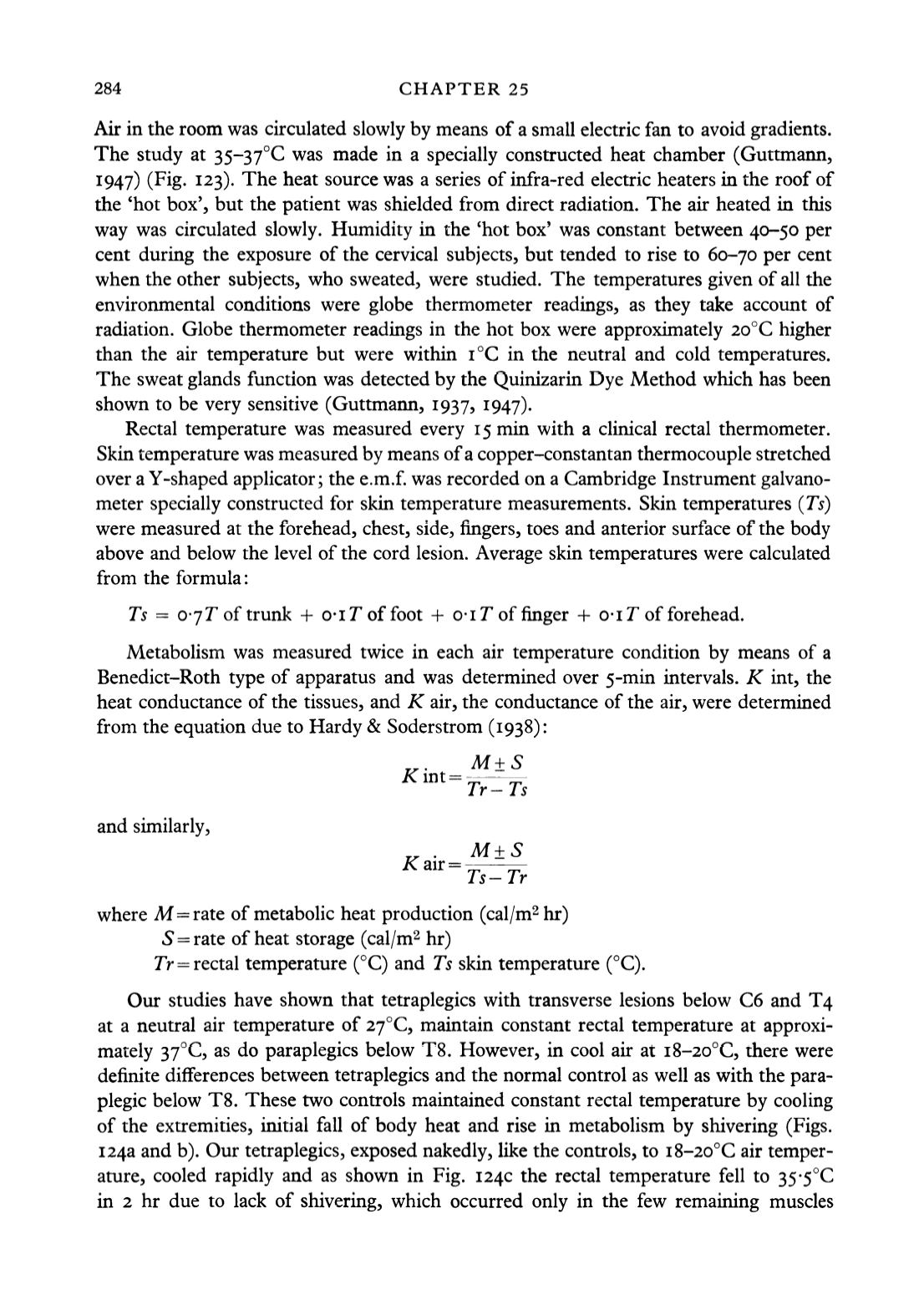
Ts = o-jT
of trunk + o-iTof foot +
o-iT
of finger +
o-iT
of forehead.
Metabolism was measured twice in each air temperature condition by means of a
Benedict-Roth type of apparatus and was determined over 5-min intervals.
K
int, the
heat conductance of the tissues, and
K
air, the conductance of the air, were determined
from the equation due to Hardy & Soderstrom (1938):
M±S
Tr— Ts
and similarly,
•
M±S
Ts— Tr
where
M
= rate of metabolic heat production (cal/m2 hr)
S =
rate of heat storage (cal/m2 hr)
Tr =
rectal temperature (°C) and
Ts
skin temperature (°C).
Our studies have shown that tetraplegics with transverse lesions below C6 and T4
at a neutral air temperature of 27°C, maintain constant rectal temperature at approxi
mately 37°C, as do paraplegics below T8. However, in cool air at i8-20°C, there were
definite differences between tetraplegics and the normal control as well as with the para
plegic below T8. These two controls maintained constant rectal temperature by cooling
of the extremities, initial fall of body heat and rise in metabolism by shivering (Figs.
1243 and b). Our tetraplegics, exposed nakedly, like the controls, to i8-20°C air temper
ature, cooled rapidly and as shown in Fig. I24C the rectal temperature fell to 35'5°C
in 2 hr due to lack of shivering, which occurred only in the few remaining muscles


