CHAPTER 25
292
(1930) and Schwartz (1937) on s^in resistance ('psychogalvanic reflex') are of import
ance. These authors found that stimulation of the cat's motor cortex gave rise to a distinct
drop in skin resistance mainly on the contralateral side of the body, and it is well known
that the galvanic skin response depends mainly on the activity of the sweat glands.
While some of these observations demonstrate some excitatory eifect of the cortical
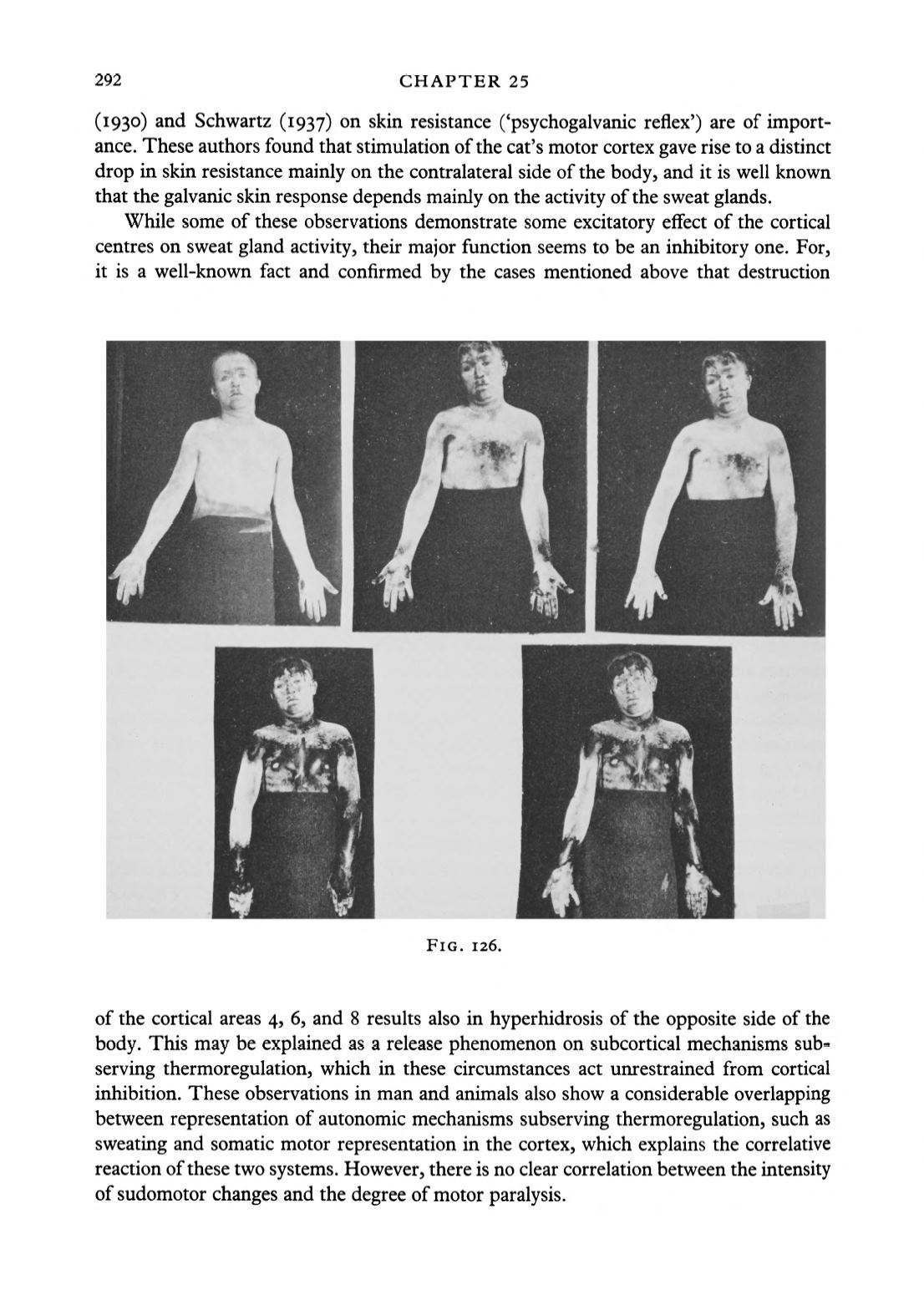
centres on sweat gland activity, their major function seems to be an inhibitory one. For,
it is a well-known fact and confirmed by the cases mentioned above that destruction
FIG. 126.
of the cortical areas 4, 6, and 8 results also in hyperhidrosis of the opposite side of the
body. This may be explained as a release phenomenon on subcortical mechanisms sub
serving thermoregulation, which in these circumstances act unrestrained from cortical
inhibition. These observations in man and animals also show a considerable overlapping
between representation of autonomic mechanisms subserving thermoregulation, such as
sweating and somatic motor representation in the cortex, which explains the correlative
reaction of these two systems. However, there is no clear correlation between the intensity
of sudomotor changes and the degree of motor paralysis.


