F- CLINICAL ASPECTS OF SPINAL CORD INJURIES
299
better tolerance to heat. The thermal readjustment is due to the improved vasomotor
control and the increased function of those sudomotor fibres which initially escaped
permanent damage at the time of injury.
The question arises whether and to what extent the isolated cord itself can take part
in this process of thermoregulatory readjustment, similar to its co-ordinated reflex
function in restoring posture. Randall & Seckendorf (1961) described sweating, though
considerably reduced below the level of the lesion, in 5 patients with complete transection
of the cord at various levels (verified by laminectomy) i to 11 years after injury. These
findings were contrary to Benzinger's conclusions (1959, 1960) that cutaneous thermo-
receptive impulses play no part in the production of sweat. This problem has been
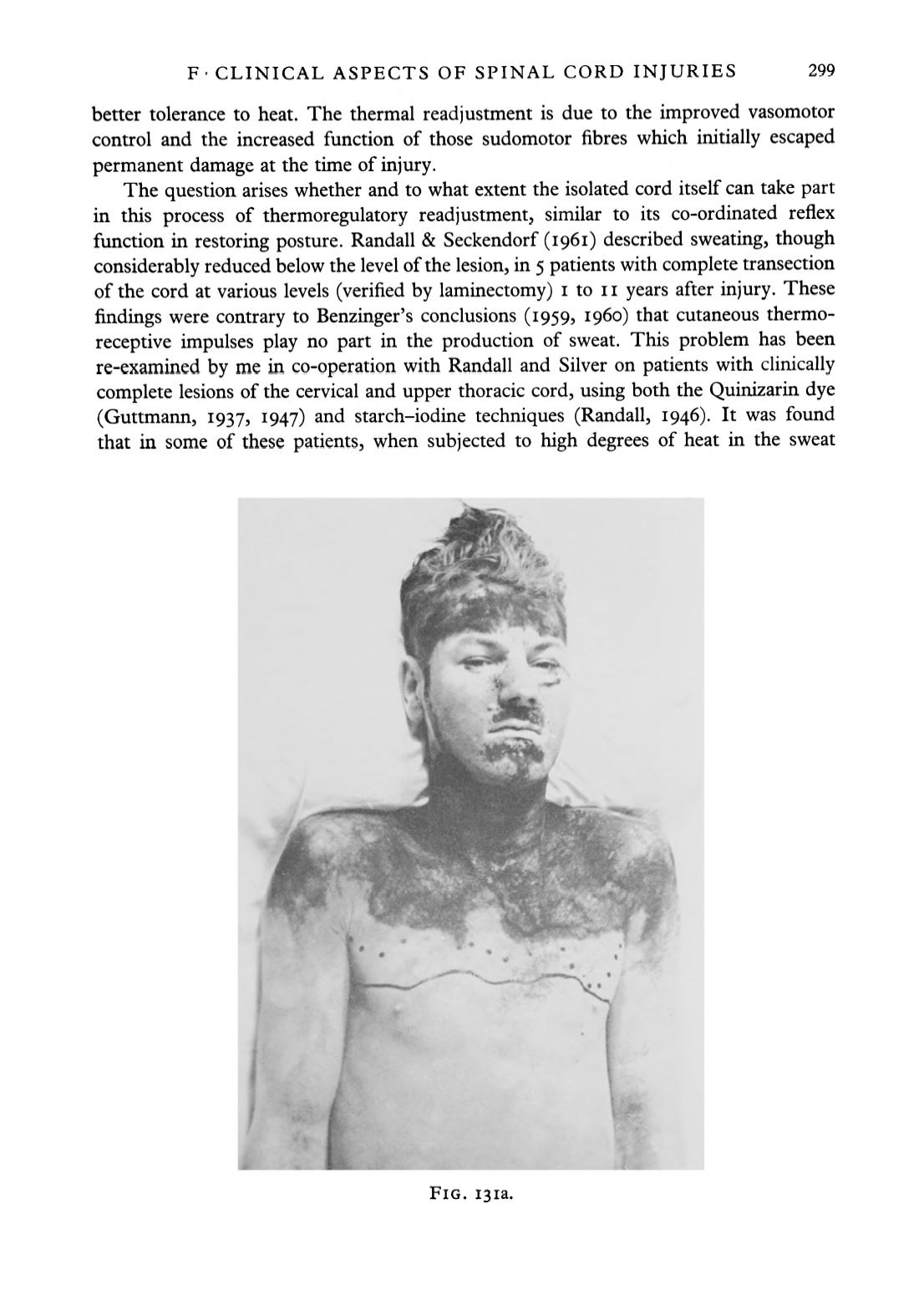
re-examined by me in co-operation with Randall and Silver on patients with clinically
complete lesions of the cervical and upper thoracic cord, using both the Quinizarin dye
(Guttmann, 1937, 1947) and starch-iodine techniques (Randall, 1946). It was found
that in some of these patients, when subjected to high degrees of heat in the sweat
FIG. 1313.


