296
CHAPTER 25
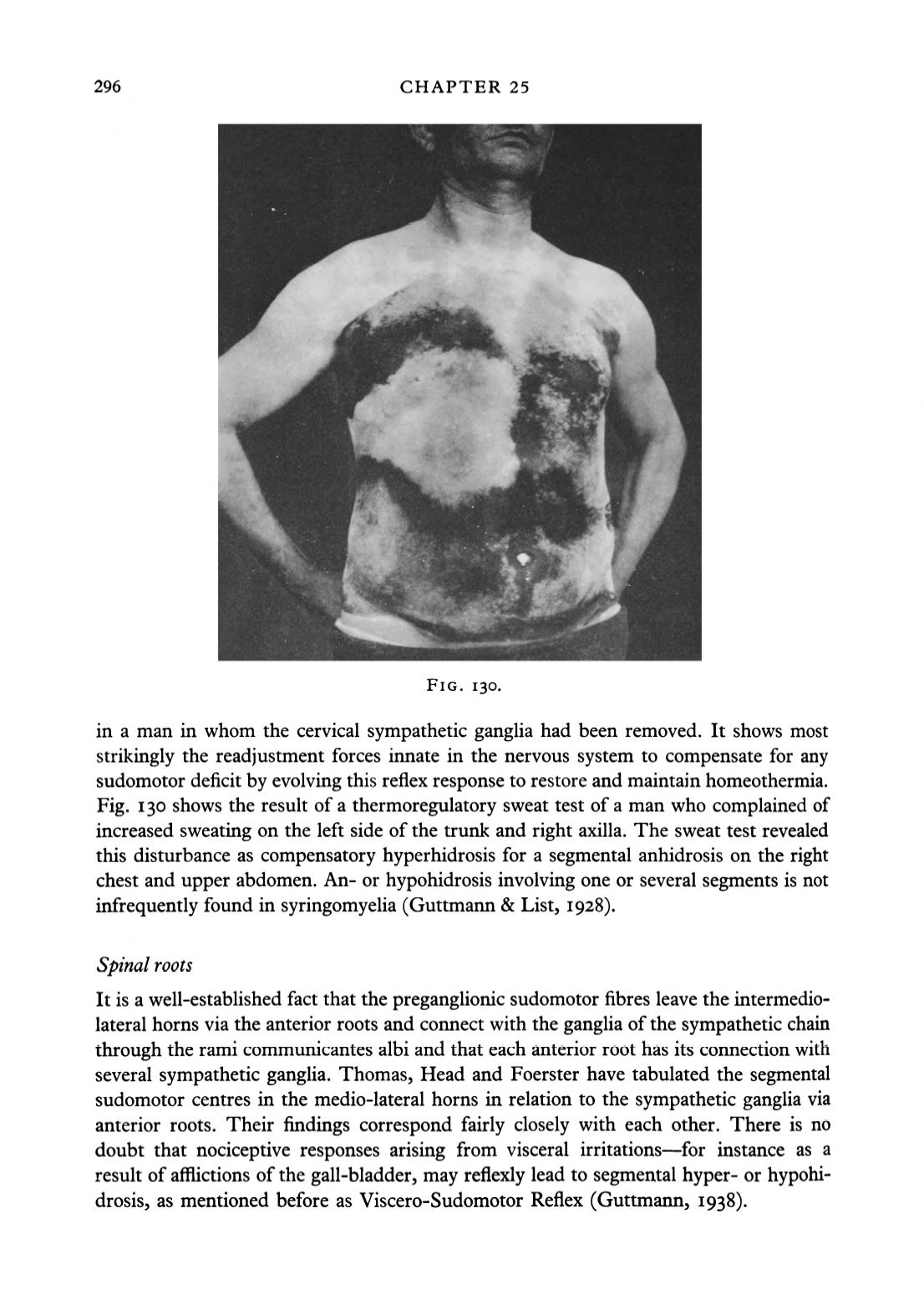
FIG. 130.
in a man in whom the cervical sympathetic ganglia had been removed. It shows most
strikingly the readjustment forces innate in the nervous system to compensate for any
sudomotor deficit by evolving this reflex response to restore and maintain homeothermia.
Fig. 130 shows the result of a thermoregulatory sweat test of a man who complained of
increased sweating on the left side of the trunk and right axilla. The sweat test revealed
this disturbance as compensatory hyperhidrosis for a segmental anhidrosis on the right
chest and upper abdomen. An- or hypohidrosis involving one or several segments is not
infrequently found in syringomyelia (Guttmann & List, 1928).
Spinal roots
It is a well-established fact that the preganglionic sudomotor fibres leave the intermedio-
lateral horns via the anterior roots and connect with the ganglia of the sympathetic chain
through the rami communicantes albi and that each anterior root has its connection with
several sympathetic ganglia. Thomas, Head and Foerster have tabulated the segmental
sudomotor centres in the medio-lateral horns in relation to the sympathetic ganglia via
anterior roots. Their findings correspond fairly closely with each other. There is no
doubt that nociceptive responses arising from visceral irritations—for instance as a
result of afflictions of the gall-bladder, may reflexly lead to segmental hyper- or hypohi
drosis, as mentioned before as Viscero-Sudomotor Reflex (Guttmann, 1938).


