F- CLINICAL ASPECTS OF SPINAL CORD INJURIES
289
c
1
0 o
•2?
E S
§8
^L rt
1 c
>>
M
1 !
-o *
0 o
_O «*=
« bO
w .E
**~ 0.
jg «ii
V
t_
(J
c
7
6
S
4
3
2
1
0
-1
r~
-
-
•
.
-
4
-
*
•
~
• *
/
• •• *
*
'
I
I
I
t
I
I
1
1
1
1
1
1
1
1
1
1
I
1
1
1
I
I
I
C5 C7
T2
T4
T6
T8
T10 T12
L2
L4
S
C6
T1
T3
T5
T7
T9
T11
L1
L3
|_5
Level of lesion
No lesion
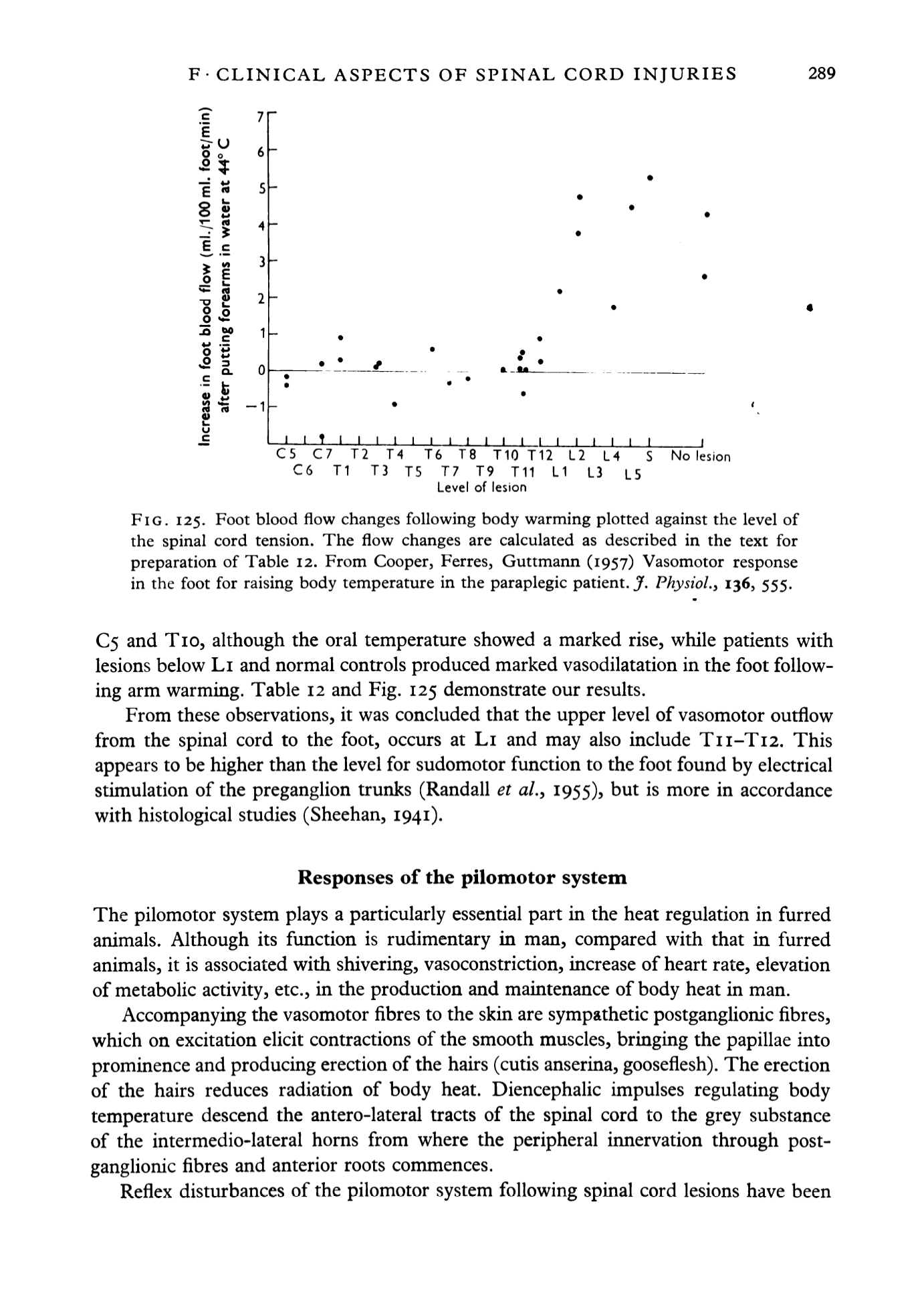
FIG. 125. Foot blood flow changes following body warming plotted against the level of
the spinal cord tension. The flow changes are calculated as described in the text for
preparation of Table 12. From Cooper, Ferres, Guttmann (1957) Vasomotor response
in the foot for raising body temperature in the paraplegic patient.
J. PhysioL,
136,,
555.
C5 and Tio, although the oral temperature showed a marked rise, while patients with
lesions below Li and normal controls produced marked vasodilatation in the foot follow
ing arm warming. Table 12 and Fig. 125 demonstrate our results.
From these observations, it was concluded that the upper level of vasomotor outflow
from the spinal cord to the foot, occurs at Li and may also include Tn-Ti2. This
appears to be higher than the level for sudomotor function to the foot found by electrical
stimulation of the preganglion trunks (Randall
et at.,
1955), but is more in accordance
with histological studies (Sheehan, 1941).
Responses of the pilomotor system
The pilomotor system plays a particularly essential part in the heat regulation in furred
animals. Although its function is rudimentary in man, compared with that in furred
animals, it is associated with shivering, vasoconstriction, increase of heart rate, elevation
of metabolic activity, etc., in the production and maintenance of body heat in man.
Accompanying the vasomotor fibres to the skin are sympathetic postganglionic fibres,
which on excitation elicit contractions of the smooth muscles, bringing the papillae into
prominence and producing erection of the hairs (cutis anserina, gooseflesh). The erection
of the hairs reduces radiation of body heat. Diencephalic impulses regulating body
temperature descend the antero-lateral tracts of the spinal cord to the grey substance
of the intermedio-lateral horns from where the peripheral innervation through post
ganglionic fibres and anterior roots commences.
Reflex disturbances of the pilomotor system following spinal cord lesions have been


