282
CHAPTER 25
found effectual in preventing hyperthermia (Cheshire & Coats, 1966). According to
Benedict & Lee (1938), the value of hypothermia lies in a reduction of the oxygen require
ment of living tissues as their temperature falls, and, according to Bigelow
et al.
(1950)
and Horvath
et al.
(1953), oxygen requirements at 34°C are approximately 20^ less than
at 37°C. The lowest temperature in acute tetraplegics recorded at the Stoke Mandeville
Spinal Centre was 29°C and the highest 40-40-6°C. However, two of our patients—one
with a severe though incomplete lesion below C4, the other with an incomplete below C6,
who developed, after cervical cord injury, a brain-stem complication with unconscious
ness for several days—developed hyperthermia of 42°C and 4i°C respectively. Both,
however, recovered following largactyl injections, intravenous drips of ice-cold saline,
and kept in a cool room covered with sheets only. Both are still alive, with their incom
plete tetraplegia of spastic type and speech disturbances of brain-stem type (slow, hesi
tant and slurred speech which is particularly pronounced in the case with the C4 lesion).
Detailed experimental studies on temperature control in late stages of tetraplegia and
paraplegia were carried out by me in 1958 in co-operation with Silver and Wyndham on 4
cervical patients (one incomplete with touch sensation present to Li-L3 on right side
only), two thoracic lesions (T4 and T8) and a normal control.
The same experimental procedure was adopted in each study. The subjects, all in
good health condition, were stripped and rested nude for i hr on hospital beds at an
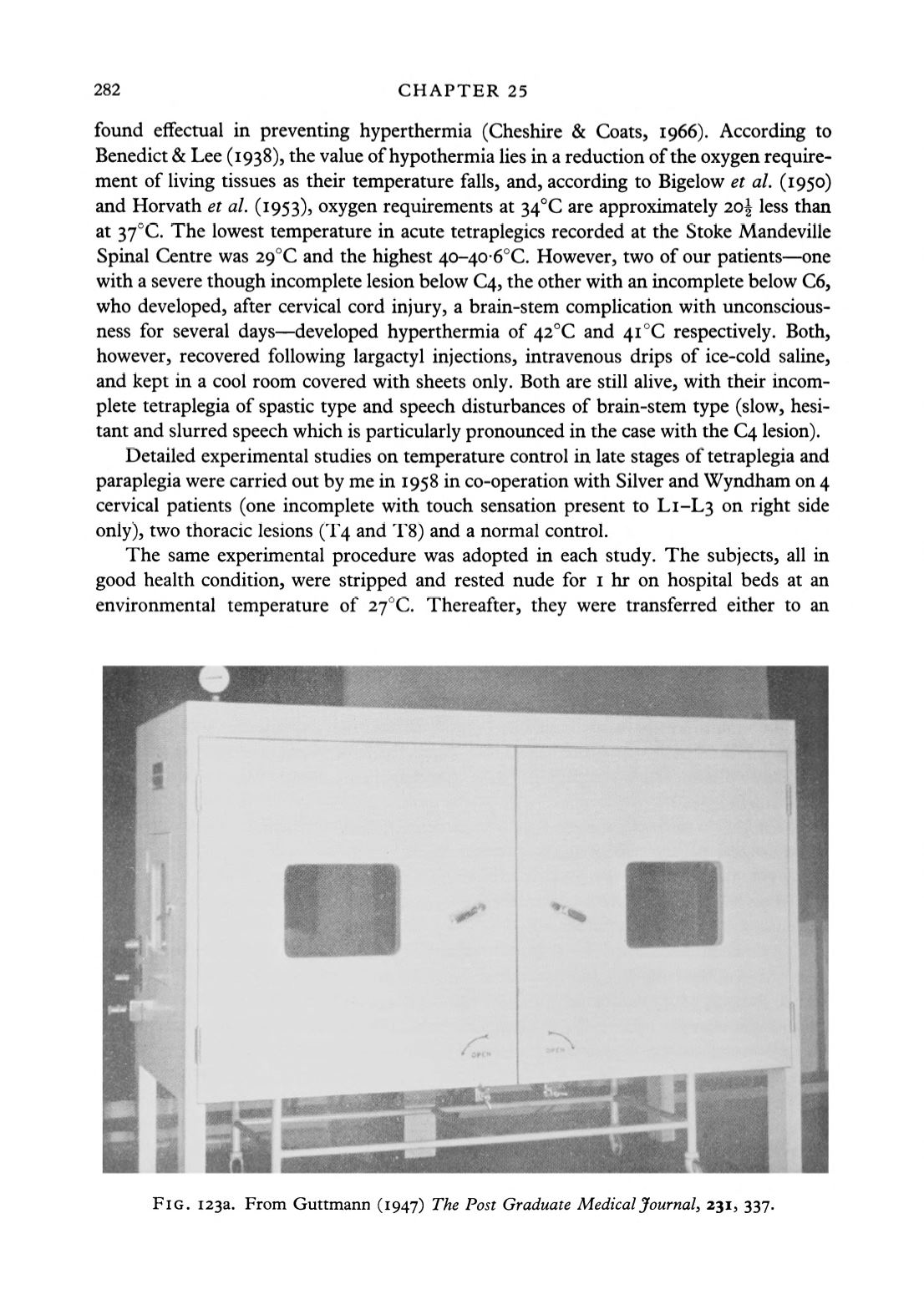
environmental temperature of 27°C. Thereafter, they were transferred either to an
FIG. 1233. From Guttmann (1947)
The Post Graduate Medical Journal,
231, 337.


