78
CHAPTER 8
Intermediate and late stages
These stages of absorption and reparative organization, which may take many weeks
and months after the acute stage has elapsed, are described together as they are inter–
mingled, especially in the more progressed stage of reparative organization. The early
intermediate stage is characterized by invasion of lymphocytes and there is also macroglial
proliferation the latter provided the parenchyma has not been completely destroyed
initially and by large macrophages. According to Greenfield
et al.
(1958) and Hughes
(1965)5 the most striking cell everywhere is the lipid phagocyte or compound granular
corpuscle. Their function is the absorption of necrotic tissue. The replacement of the
perished parenchyma is carried out by fibroblasts. Therefore, according to the time
which has elapsed after the acute stage, one will find various phases of reparative organiza–
tion in those cases of severe contusion with extension to segments cephalad and caudal
from the main destruction of the cord.
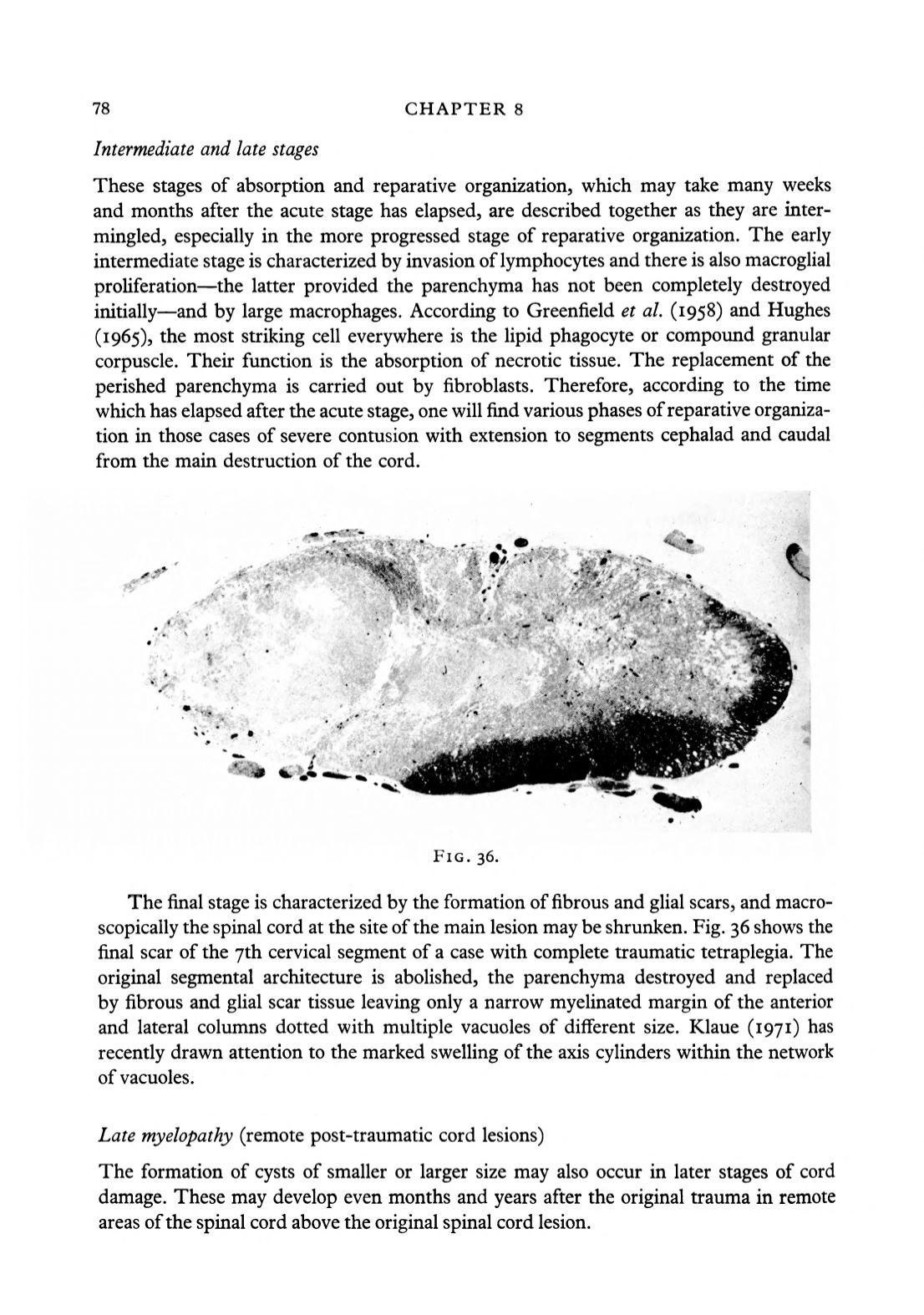
FIG. 36.
The final stage is characterized by the formation of fibrous and glial scars, and macro-
scopically the spinal cord at the site of the main lesion may be shrunken. Fig. 36 shows the
final scar of the yth cervical segment of a case with complete traumatic tetraplegia. The
original segmental architecture is abolished, the parenchyma destroyed and replaced
by fibrous and glial scar tissue leaving only a narrow myelinated margin of the anterior
and lateral columns dotted with multiple vacuoles of different size. Klaue (1971) has
recently drawn attention to the marked swelling of the axis cylinders within the network
of vacuoles.
Late myelopathy
(remote post-traumatic cord lesions)
The formation of cysts of smaller or larger size may also occur in later stages of cord
damage. These may develop even months and years after the original trauma in remote
areas of the spinal cord above the original spinal cord lesion.


